“Power Supply Adjustment”

So Austin Energy added almost $200 to our August Power bill as a “power supply adjustment”. What a rip off. Thanks ERCOT!

Power Supply Adjustment — The Power Supply Adjustment is a dollar-for-dollar recovery that includes the cost of fuel for our power plants, the cost of electricity purchased from the grid and any net charges experienced as Austin Energy sells power to the grid.

UPDATE: seems these have been on our power bills for at least a year. Probably averaging $150 or so. My contribution to the Friends Of ERCOT fund.

New Orleans September 2023

I turned on the my phone last night as the plane was landing. A message from my daughter was waiting saying: stay at the airport! I wasn’t sure what that meant. It seems baseball sized hail was moving through north Austin, heading for the airport. The landing was a bit rough but everything looked fine at the airport. Except there wasn’t a gate available. Really? It’s after 9pm and I know they knew we were coming. Only waited 15 minutes on the tarmac but it made me nervous. No announcements about the weather from the crew.

We had come from a short trip to visit Mom in New Orleans. We joke when we booked it that a hurricane would probably hit while we were there. Something always seems to disturb our travels to visit family. Actually our daughter was supposed to come with us, but she picked up COVID just before we left and wasn’t able to travel with us. Maybe good luck for us. She was the only thing that kept us from getting on the road and driving right into this storm.

There were no warnings and no news at the airport. We hunkered down for about two hours, as heavy rain and light hail moved through. Texted our neighbors and they said our neighborhood was getting golfball sized hail. Plugged in our phones since watching weather radar had run down our batteries. We made it home before midnight to no serious damage to the house that we could see, just leaves stripped off of the trees covering the road and the yard. Oddly, the pool was overflowing. It looks like hail must have hit the butterfly valve on the side of the house that turns on the refill water. Glad we caught that.

Solar Testbed

It occurs to me that what I have built is a solar testbed. This is a word we used to use for computer systems not really made to perform work, but to run experiments. But I haven’t really thought about actual experiments. Some thoughts:

  • Full battery cycle: completely drain the battery, perhaps at night, they do a full charge, perhaps in full sun. How long does this take?
  • Output Measurement: not clear what the total panel output is. Are all loads coming from the battery, or is power shunted directly from the panels to the load? In the dashboard it isn’t clear if battery current and load current are distinct, or overlapping. I haven’t seen much more than 100W from my 200W panels, but I have only been using about 100W of load.
  • Maximum Load: so far I have only put about 50W – 100W of load on the system. Panels are only 200W max, but what happens (of anything) if the load is higher than the panel output? (I suppose this happens right now when there is shade. This all relates to how current is applied to the load).
  • Battery Fullness: there isn’t any measure of battery fullness, perhaps as a percent. There is a table that comes with the battery that maps voltage to percent remaining. Perhaps batteries vary too much to include this in the software, but I know I would type in a small table of numbers to see this sort of battery status.
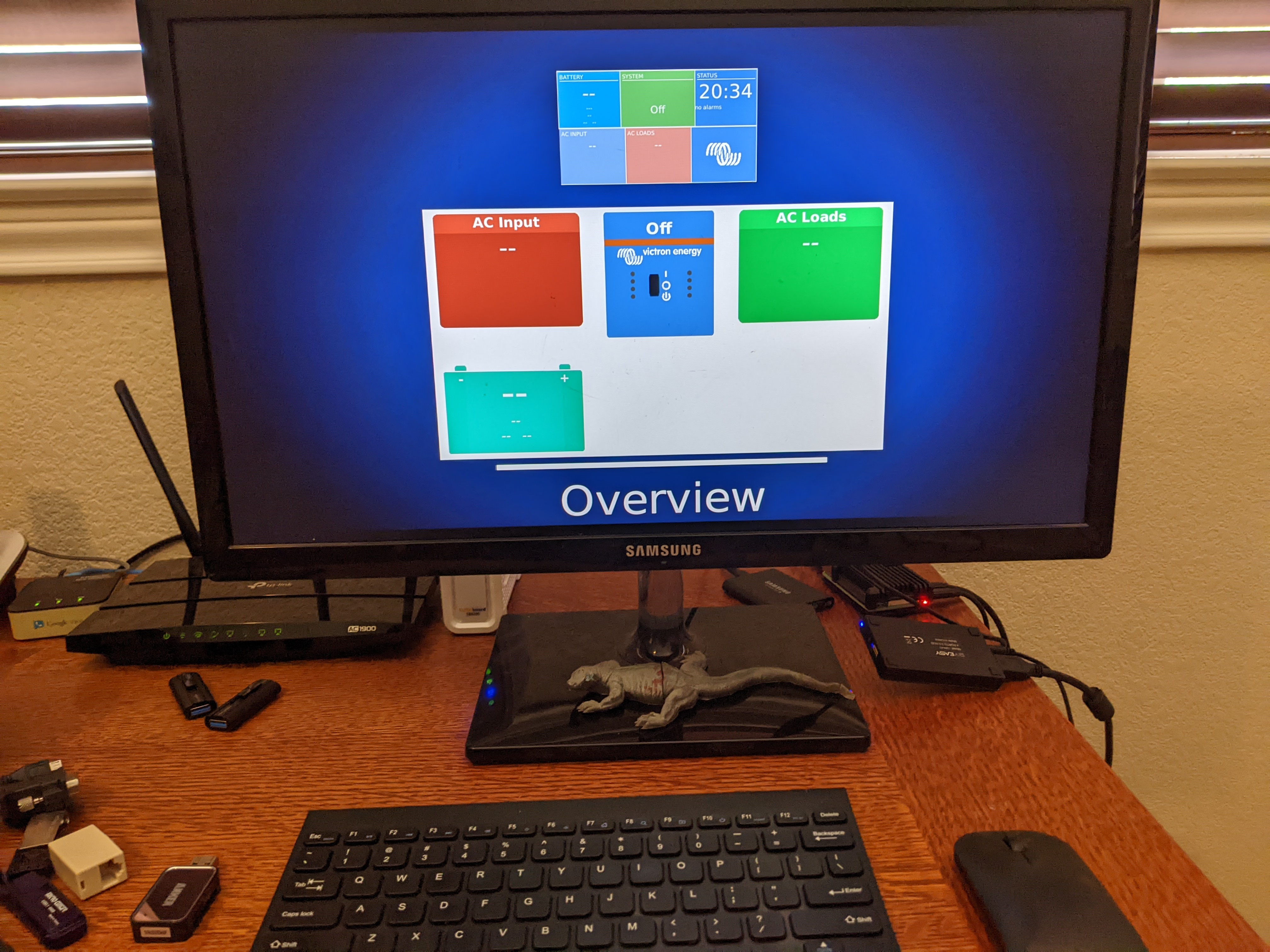
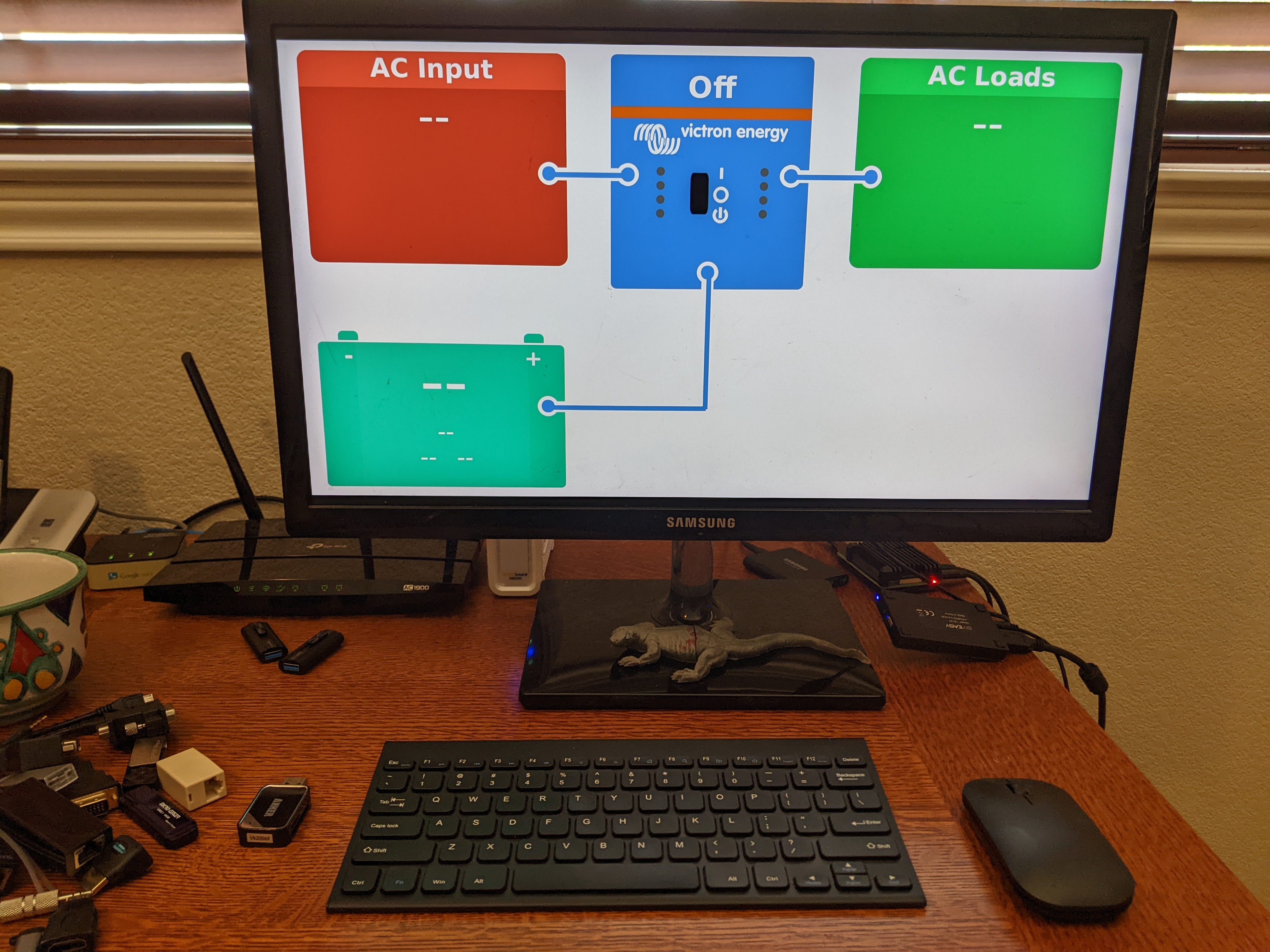
  • Raspberry Pi Interface: my next step is to get a Raspberry Pi and load up the Venus OS interface and see what this buys me. I would like to log all the parameters at say, one minute intervals, perhaps averaged over 5 one second measurements. Then run the system for a week or so under a stable load and look at the graphs and see what stands out.

Early Solar Experiences

Have had the solar setup running for a few days. It happens to be the first cloudy and rainy days in months, but that is a good thing. I get to see how things perform in various conditions. As I said this is really mostly a toy for learning purposes. I can’t say I have a good feel for things just yet but here are some early observations and notes.

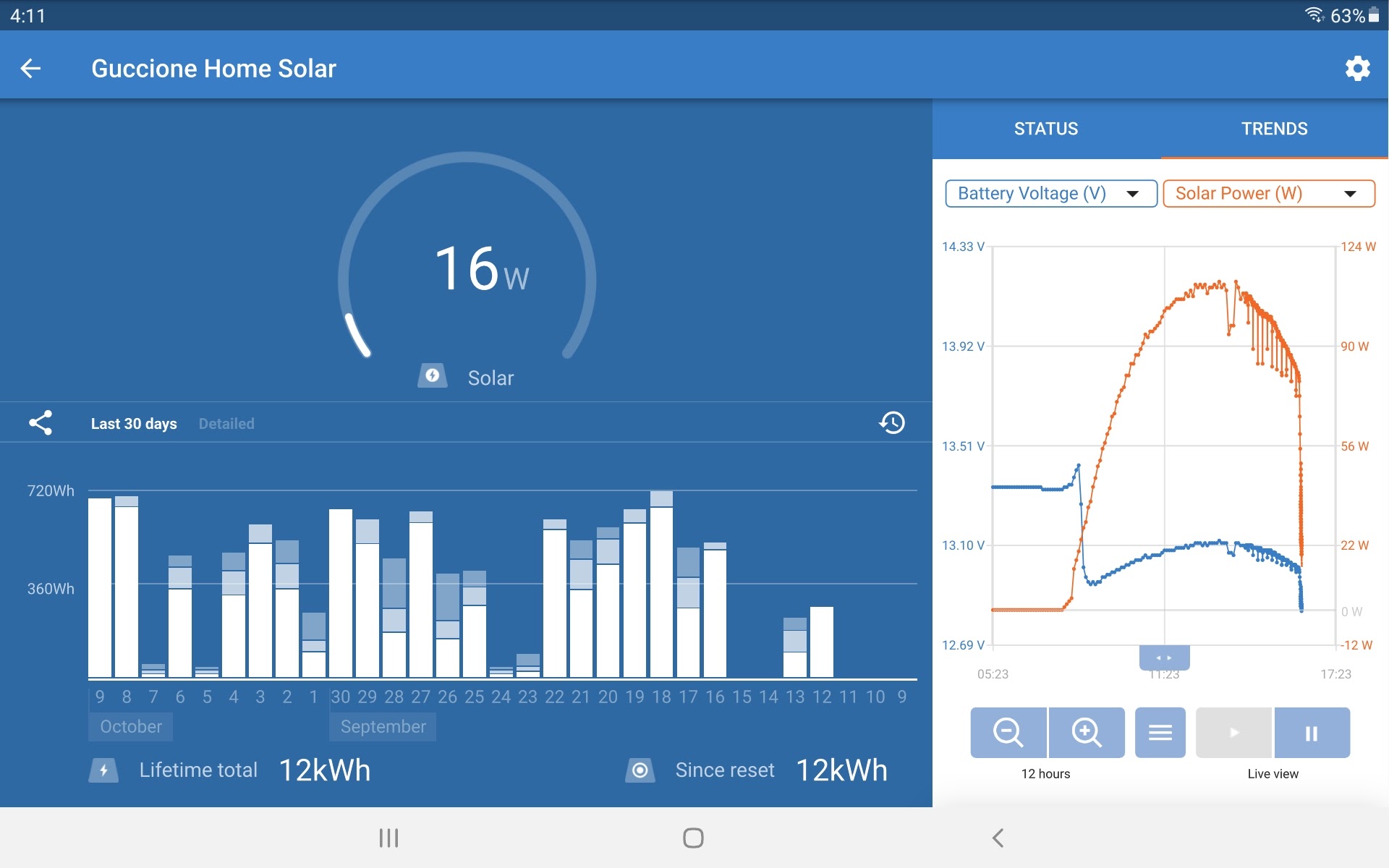
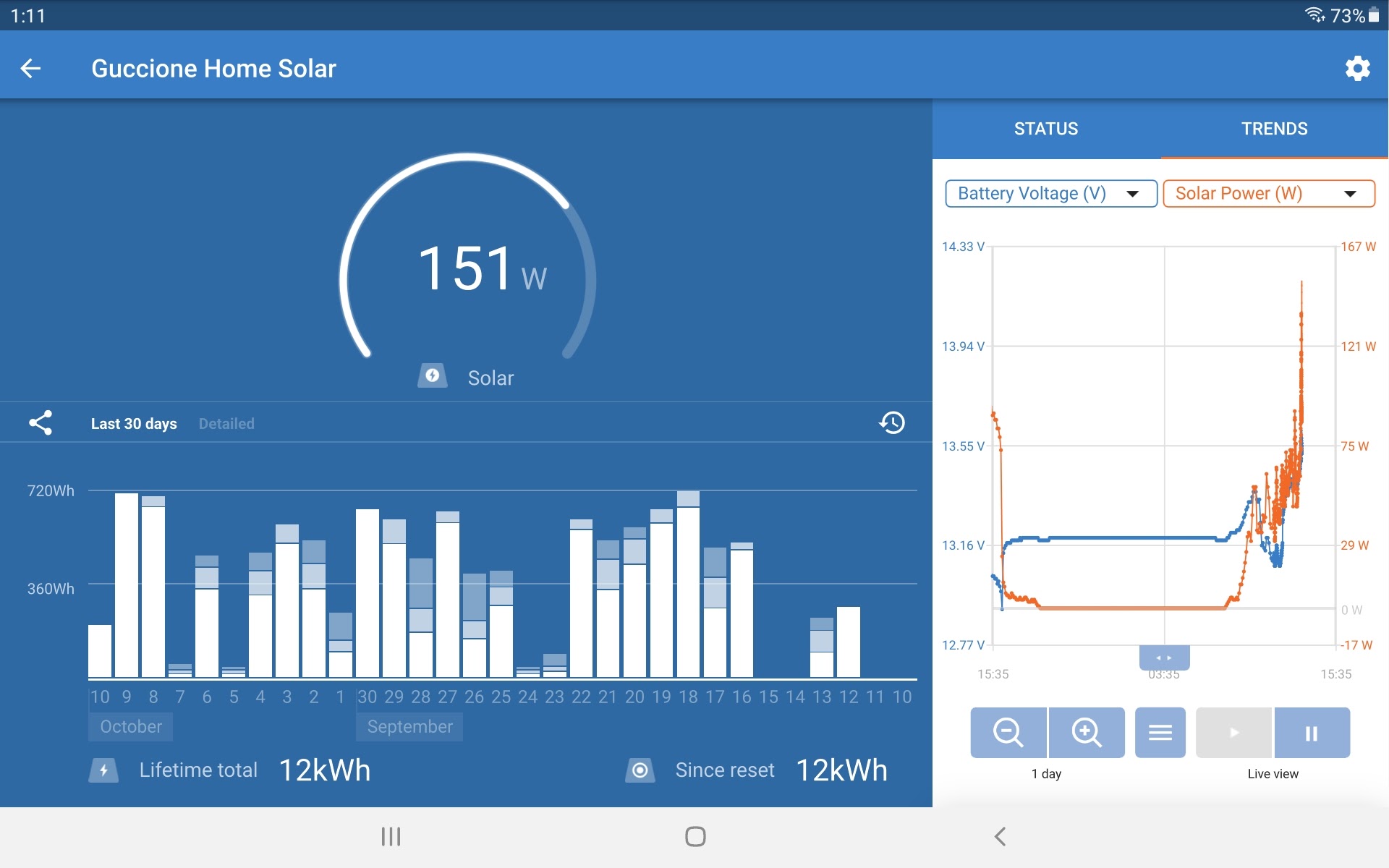
  • Victron software: very nice stuff. Has a dashboard that connects via Bluetooth. I’ve accessed it probably a hundred times in the last few days. Gives a good view of the instantaneous state with some timeline graphing of two selected parameters.
  • Power generation: I assumed there would be some measure of potential power being generated, but maybe this isn’t realistic. There is a power consumed, but this depends on the load and the state of the battery, not some theoretical available power.
  • System bottlenecks: all systems have bottlenecks. In this sort of arrangement they seem to be current based. My battery, for instance, can take something like a 40A charge current. But the controller can only deliver 15A. And I’ve seldom seen it past 3A. Since I have two 100W panels, this is maybe 20A peak. I’m starting to think viewing everything in Watts makes the most sense. I’m sure the pros do more serious analysis than I do and probably have better results.
  • Panel output: I didn’t expect to see peak output but it is more elusive than I expected. My inverter is oversized at about 500W but I would have to have a large load, bright sun overhead and probably a low battery on bulk charge to see it. Angle of sun and clouds have a big effect. Bright clouds cuts output more or less in half and heavy clouds half again. Not unexpected.
  • Battery charging: interesting to see how the controller shuttles current from load to battery depending on the panel output. If course that is the whole point of the controller but it has been useful to watch it in various situations (low battery, cloudy skies).
  • Victron Data: the Victron software let’s you download data. But as best I can tell it is only daily averages. I’m thinking I want maybe minute by minute voltage and current of panel, load and battery. Looking at the Raspberry Pi solution. Probably my next step.