I’ve kept up with this over the years (decades?). The protection mechanisms for anti-piracy have made many devices unrepairable. Note that this is more of an American problem, that many DRM systems aren’t used in the rest of the world. What I didn’t realize is that this has begun to reach into places I didn’t expect. Like John Deere tractors. From The Conversation.
China announces CPU-only exascale supercomputer
I spent most of my career in compute acceleration. Originally this meant FPGAs (reconfigurable logic) but later GPUs. As I built larger and larger GPU machines using Intel server CPU and Nvidia GPUs the idea of smaller and simpler processors became more appealing. I’ve been a fan of the Barcelona Supercomputer Center Mount Blanc machine as well as the SpiNNaker at Manchester for some time.
While GPUs won the battle for now, the power consumption and price seem to be pointing back in the direction of smaller, lower power processors, perhaps with more tightly coupled, on-chip, parallel accelerators.
China seems to be moving in that direction with their new 2 Exaflop Lingshen machine using only low-power CPUs. This machine has only homegrown (Chinese) processors and no GPUS. This is quite a difference from supercomputers of the last decade or so, as well as all the new AI data centers.
China announces CPU-only exascale supercomputer with 47,000 homemade processors, record 2 Exaflops of performance without GPUs — Lingshen super said to use Huawei Kunpeng servers and no foreign-made components
AI Memory Shortage
No, not that one. The one on my home devices where Google is jamming a 4 GB AI file on Chrome browser users. From XDA.
Chrome quietly installed 4GB of AI files on my PC — here’s how to remove them
Hawaii Just Found a Way to Keep Corporations Out of Politics
So corporations aren’t people after all. At least in Hawaii. From The American Prospect.
Hawaii Just Found a Way to Keep Corporations Out of Politics
Iran unveils crypto insurance regime for Hormuz
More or less a toll. But implemented like an old fashioned “protection” racket. Haven’t seen this mentioned in the US media. From the Asia Shipping Media site Splash247.
Iran unveils crypto insurance regime for Hormuz
The American epoch of oil is collapsing. What comes next could be ugly
Longer read from The Guardian (UK).
The American epoch of oil is collapsing. What comes next could be ugly
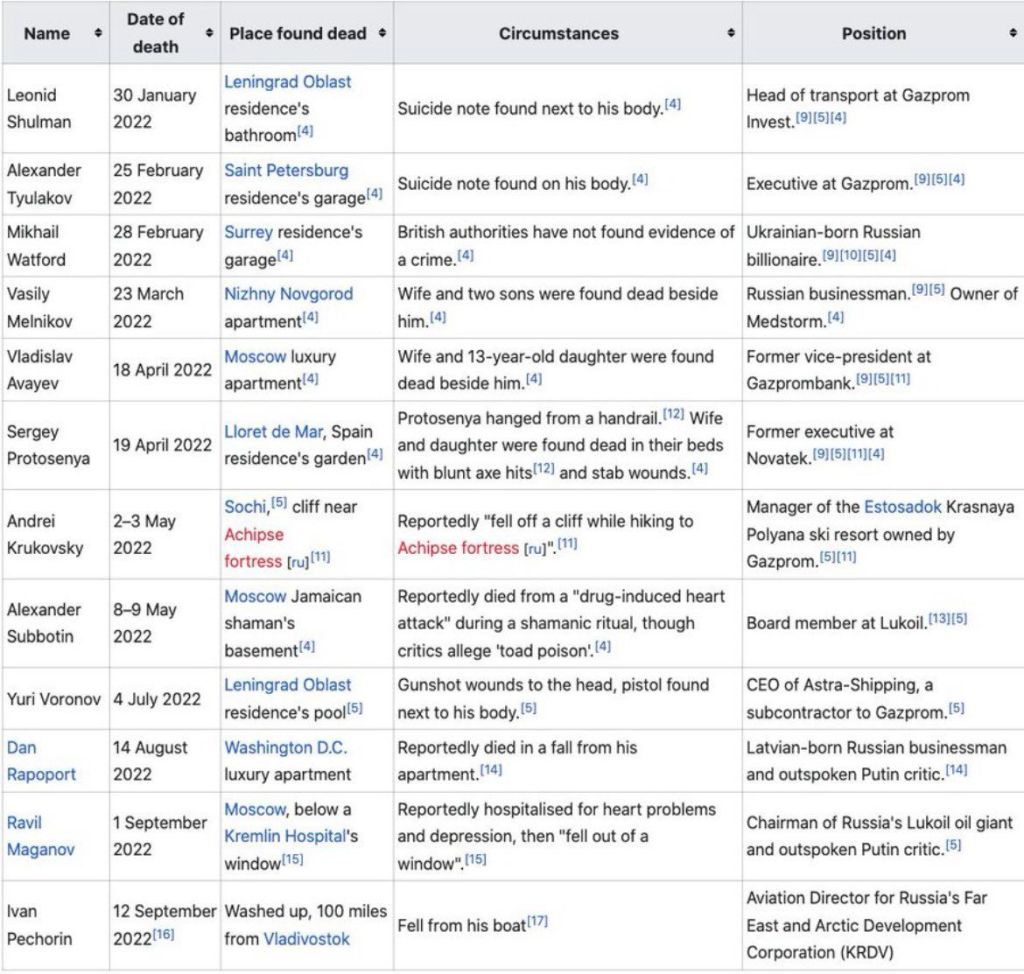
And Then There Were None
I was wondering about all of the original Russian Oligarchs who got fantastically wealthy in the “free market reforms” after the fall of the Soviet Union.
I suppose if you have money, you want power. And if you have power, you want money. So conflict was inevitable between the Oligarchs and their rulers.
The Mafia-style economy and government of Russia led to Mafia-style conflicts and, ahem, resolutions. It seems none of the original Oligarchs are left. All died in mysterious circumstances. Some good folks did the work for me and put together a list. I wonder if Elon Musk and his ilk are fans of history. I suspect not.
New Mexico tribes sue Kalshi, alleging illegal sports betting on tribal lands
There’s illegal gambling going on online? I’m shocked! (Apologies to Casablanca). From the Albuquerque Journal.
New Mexico tribes sue Kalshi, alleging illegal sports betting on tribal lands
Trump vs The Catholic Church, New Mexico Edition
Probably more of a local story from KTSM. The last line sort of cracked me up.
The Diocese says this property is part of a holy site. Atop the mountain sits a 29-foot-tall limestone statue of Jesus Christ “that serves as a shrine to thousands of faithful in the El Paso and Southern New Mexico area.”
…
KTSM has reached out to the Department of Justice for comment and about the government’s plans for the statue of Jesus Christ that sits atop of the mountain.
Federal government seeks to condemn Mount Cristo Rey for border security
Albuquerque vs Alburquerque
We are planning a trip to Portugal later in the year. I was googling around and found out there was a famous Portuguese explorer responsible for much of that country’s success in that era named Afonso de Albuquerque. I’ve heard of Henry the Navigator, Vasco de Gama and maybe some other Portuguese explorers, but I don’t think I’ve ever heard of this Albuquerque fellow. He seems to be quite important to the Portuguese success during those times.
I also learned there are two different Dukes, one in Spain and one in Portugal that spell the name differently: Duke of Alburquerque (Spanish, with an “r”) and Duke of Albuquerque (Portuguese, without the “r”)
These days I live just outside of Albuquerque, New Mexico and it definitely has a Spanish history, but the name of the city follows the Portuguese spelling. It also seems the city changed its spelling at some point. Around 1858 a French priest began to use the Portuguese spelling and somehow, inexplicably, it stuck.
I admit I still probably would have trouble spelling either version, since I mostly rely on auto-complete for this one. BTW, spell check flags the “r” spelling as incorrect. I suppose that is mostly right.

