I have a good friend, a European who has been in the US for decades, who has always said “America runs on resentment”. I was never exactly sure what he meant, but I find it funny that Paul Krugman picks this idea up in his final New York Times article. I have always been a fan of Krugman. I didn’t always agree with him and he wasn’t always right, but he was always honest, perhaps to a fault.
The One Percenters
Nobody I know is going back.
After buying an EV, less than 1% of drivers go back to gas-powered cars
Spaced Out
Last week we got a letter telling us we had to validate our home address for tax purposes. We have been living here since the 1990s and have never lived any place else and own no other properties. Easy peasy.
Except I forgot I was living in techno-dystopia called Austin, Texas.
We have the standard Homestead Exemption for taxes, as we should since this, uh, is where we live. The system involved taking a photo of your Drivers license and uploading it to a web site. We were rejected. Why? The drives license spells our street name (correctly) as “MCNEIL” while the tax office spells it “MC NEIL” (with a space). So no match.
After many calls and emails we are told it will take several weeks to resolve this issue. Which puts us past the deadline for verifying our home address. There are also dozens of similar “McNeil” addresses out there and I’m gonna assume lots of other near misses like it. I feel like I’m living in Brazil.
The Unlikely Inventor of the Automatic Rice Cooker
From IEEE Spectrum.
The Unlikely Inventor of the Automatic Rice Cooker
COVID-19 Data
Some good charts from Our World In Data.
17 key charts to understand the COVID-19 pandemic
Exponential Cost Declines
While I’m fond of the line from the old song, “things in this life change very slowly if they ever change at all” it isn’t really true. Many things, maybe most things, don’t change much at all. But some things change very quickly and in ways hard to even understand. I worked in tech and rode the big wave of semiconductor change for pretty much my entire career. But I even have a hard time with the numbers, because the scale isn’t something humans usually have to deal with. I’ve seen it explained lots of ways, but Azeem Azhar in his post Why AI, solar & batteries will keep getting cheaper spells it out in plan numbers. It’s pretty amazing. And it’s still happening, but only in a few places. Here is what happened to computing power in my lifetime.
From $190 billion for one gigaflop of compute power in 1961 to just 1.25 cents in 2023
The Primary Energy Fallacy
TL;DR: burning stuff wastes lots of energy, electricity mostly doesn’t.
My garage used to get hot. Like really hot. This being Texas, I figured maybe my garage doors needed better insulation. I thought about putting in a vent fan. And my office was over the garage and it was even noticably warmer. Recently I noticed the garage never gets hot any more. Then it hit me. The Tesla! I used to have two, sometimes three cars in that garage. Just the heat leftover after they were turned off were enough to really heat up the place. Glad I didn’t invest in new insulation!
I have also started using a little induction cooktop. It is so much better than gas (or old fashioned resistive electric). Things heat up fast and nothing else gets hot but the pot. No sweating over a meal, getting blasted by heat, and probably toxic fumes.
This article point out the massive amount of wasted energy in “thermal” power generation. You can tell this by all the excess heat given off. All that heat is energy being (literally) thrown away. So estimates of how much electricity we need to transition from thermal technologies are probably vastly over estimated, perhaps by as much as a factor of 2x to 4x.
Addendum: I have told people many times it cost me $3 – $5 to “fill up” the Tesla. This compares to maybe $30 to $50 for a similar gas car. People don’t believe it. Even techies when I show them the (relatively simple) math. Maybe this is the real explanation. Gas engines are inefficient. All that heat coming off the radiator is a complete waste. With a gas car you are basically burning a lot of fuel that does nothing to help move the vehicle. All it is doing is making the nearby area hotter.
The Primary Energy Fallacy
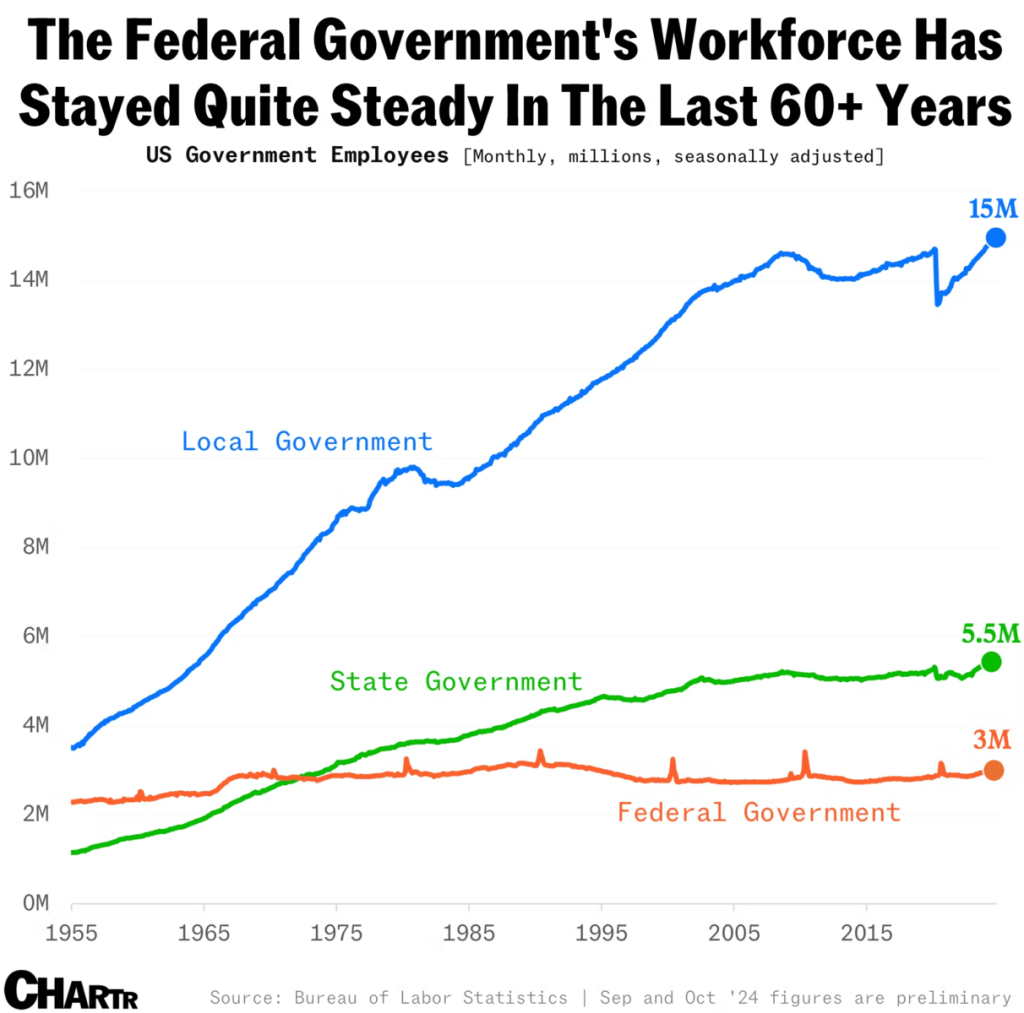
Government Employees
From The Big Picture. Seems the number of Federal Government employees has been remarkably stable over the years. Not so much for state and especially local governments. Maybe people looking to make cuts in government spending are looking in the wrong place when they look at the Federal Government.
Between the Booms: AI in Winter
A good read from CACM on the history of Artificial Intelligence. This is the second in a three part series. I’ll have to go look up the other two.
Between the Booms: AI in Winter
Planimals
No need to eat, just get some sun.
 Steven A. Guccione