From Reuters UK.
A Better Angle
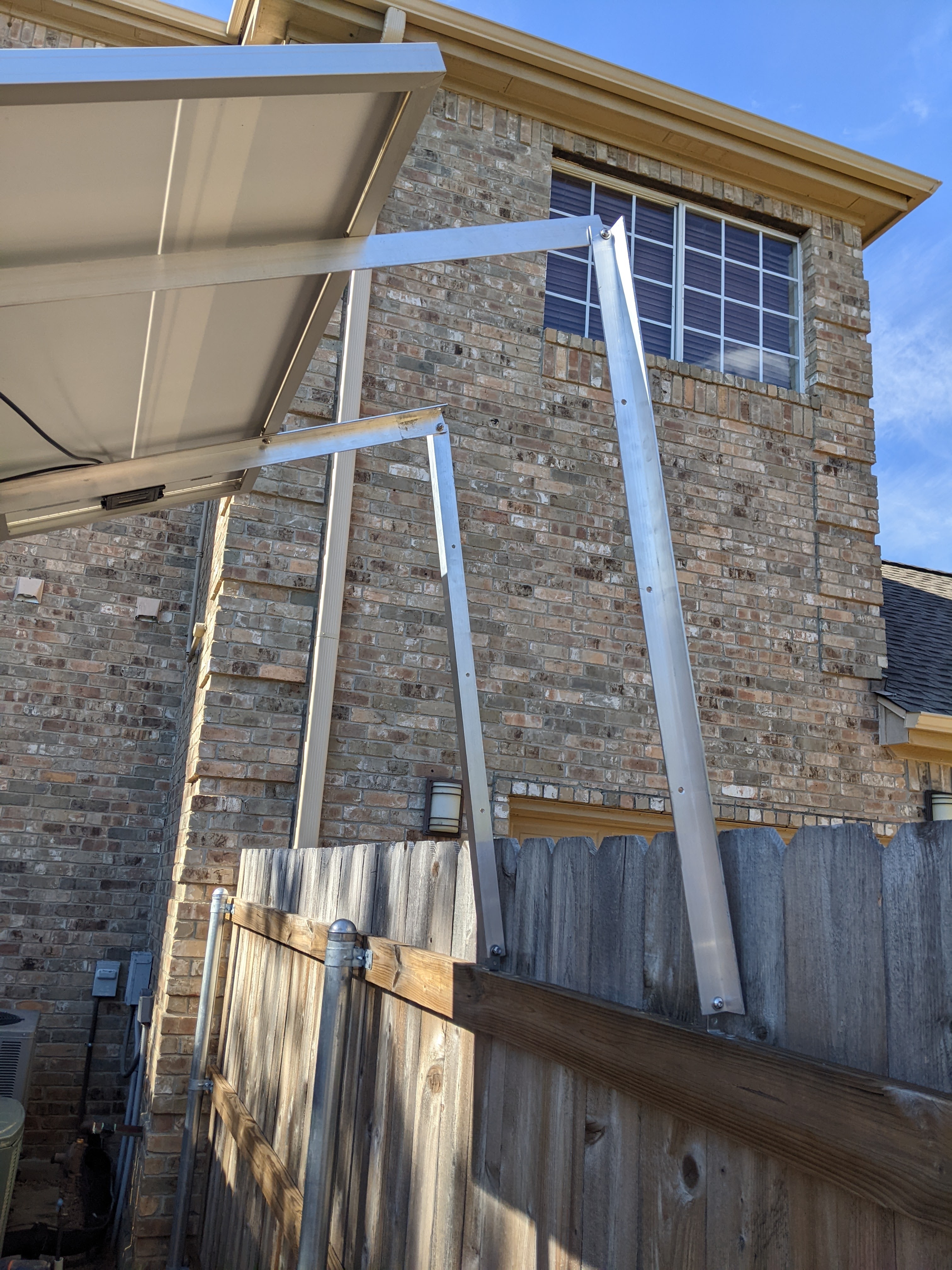
I have never really noticed how low in the sky the sun gets in winter here in Texas. With my panels laying more or less flat, the angle the sun hits the panels at is pretty low. So I decided to change the mouting to permit a change in the angle, at least in one direction.
Originally I had just attached the angle iron brackets directly to the fence with deck screws. Simple and sturdy for sure. This week I bought some brackets and two more pieces of angle iron to prop the panels up in a more southerly facing direction. I was hoping for a string of nice sunny days for a good comparison but it it looking like that isnt going to happen. But I expect a noticable change in output.
Some lessons being learned. Location is important. Right now the panels are blocked by the house (and trees) in the afternoon. I could have moved them further away from the house, and I may yet, but this used less wire and was more convenient.
I’m also getting the idea that in some old fashioned way this technology can put you in closer contact with the natural world around us. My first inclination was to think about sizing an array for absolute worst case. But maybe it is simpler to make adjustments to your lifestyle. Don’t do laundry on cloudy days. Wasn’t this how Grandma used to do it?

‘We needed to get off the grid’: New Orleans’ community-driven response to blackouts
After a history of poor performance by the privately owned power grid, the poorest New Orleanians take matters into their own hands. It was literally a matter of life and death for many. And in the end it was surprisingly easy and cost effective. A good (maybe even feel-good) read from The Guardian (UK)
‘We needed to get off the grid’: New Orleans’ community-driven response to blackouts



Why We Idolize Assholes
From Fatherly. Wonder if WordPress will censor this.
Why We Idolize Assholes
More Solar Testbed Data
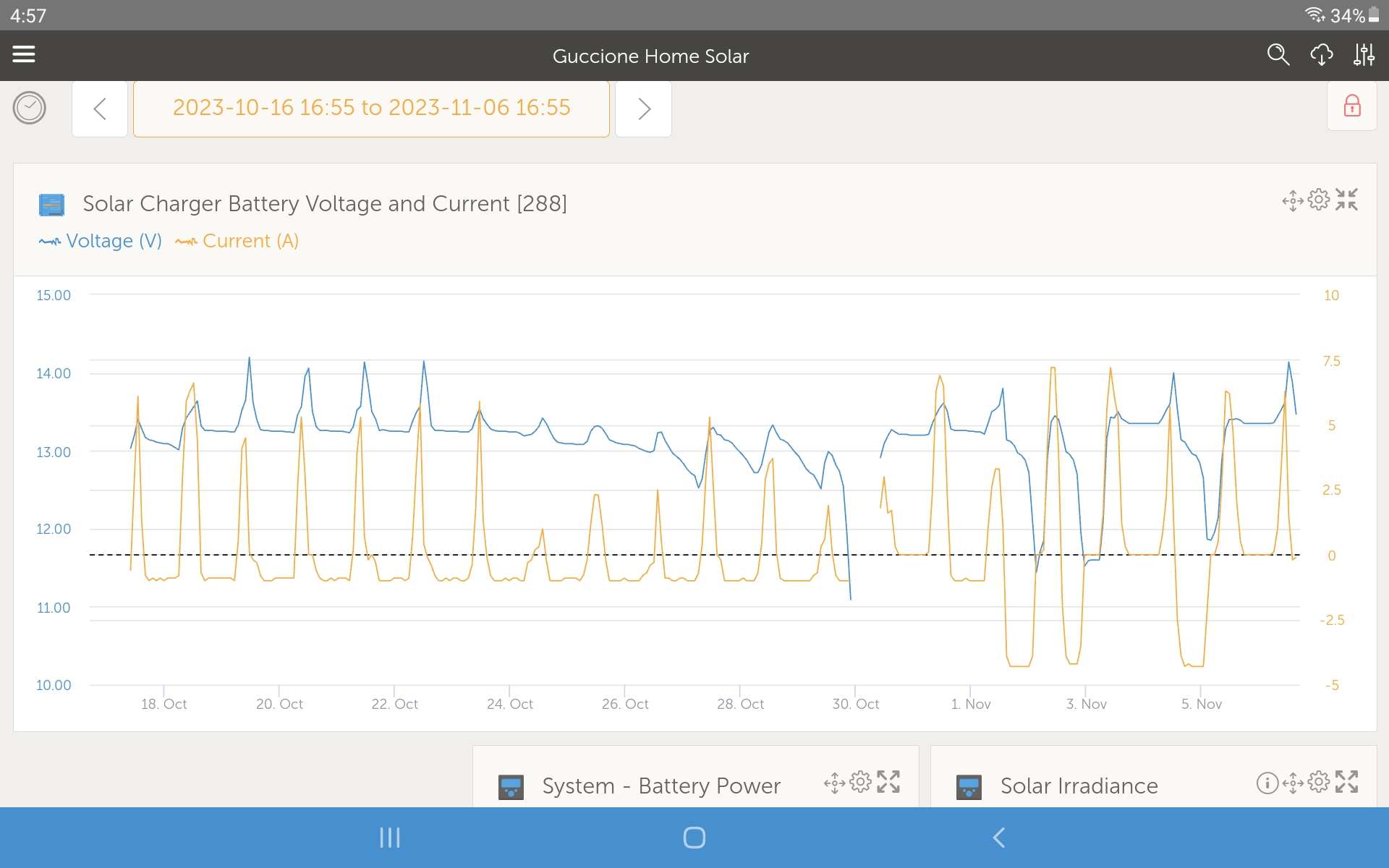
The solar Testbed has been running for a few weeks. I decided to leave an LED light on 24 / 7 just to see things cycle. Maybe 10W for the bulb another 10W for the inverter and logger. Everything is fine until there were a few cloudy days in a row. Eventually the battery fully drained, turning off the logger (the Raspberry Pi was plugged into the inverter).
I turned off the light for a few days and the sun came out and let the battery charge a bit. Expecting sunny days I turned on a larger load, maybe 60W, just to see how this cycled. Also plugged the Raspberry Pi into the wall so logging wouldn’t stop. It seems the controller is set for something called BatteryLife which is used to conserve battery life in lead acid batteries. This keeps the load turned off until the battery gets a full charge, to prevent short cycling. But I have a lithium battery and don’t care so much. I need to change this and try again. Anyway, the light would burn for a few hours in the evening and then turn off sometime in the night, charging again in the morning. But again a string of unexpected cloudy days moved in. Not enough panels + battery to keep a 60W load going full time. Lesson here is being completely off grid might be harder than it looks.
ICE Cars Gone by 2030
Prof Ray Willis post some charts demonstrating how exponential change is happening in the automobile market. He sees a Kodak-style crushing of the businesses of existing (ICE) car makers in the very near future. This is an old story in technology. Even today’s oil industry all but wiped out the vast international business of whaling in a short time. In more recent times, the transistor all but eliminated the vacuum tube. Flat screen TVs very quickly displaced tube TVs. Mobile phones all but replaced land lines. This is how technology works, and it works more quickly than most people realize.


How to Spot Corporate Bullshit
I grew up in Louisiana where bullshit is practically an art form. A good read from Current Affairs. I would add not all bullshit is corporate.
How to Spot Corporate Bullshit
Tesla sold 10X more EVs than rivals in the first three quarters of 2023
I keep seeing stories in my newsfeed about how EV sales have (at least temporarily) peaked. The story goes all the “early adopters” have bought their EVs and the rest of America is still undecided. This might be true if you are taking about the 10% of EVs sold that are non-Tesla. Truth is these are not really competitive offerings. They tend to be (very) expensive and do not have an realistic charging story. By this I mean both a fast charger network as well as a country wide network that would allow long distance travel. Clearly the legacy auto makers still needs to make some serious investments. One wonders how much better Tesla would be doing if their CEO didn’t aleniate so many potential customers.
Tesla sold 10X more EVs than rivals in the first three quarters of 2023
Solar on Cloudy Days
Have been running an experiment on the solar testbed. I kept a regular household LED bulb running 24 / 7 for over a week, just to watch the graphs go up and down. The light draws maybe 10W and the controller maybe another 10W. We have had a long streak of cloudy days and I noticed the light was off this morning. Checking the VRM it seems that it has been off for 12 hours. The inverter is also off. Looking at the graph it seems the battery was gradually drained, then it fell off of a cliff sometime during the night. I’m going to leave everything as is a see what happens when the sun comes back out, perhaps tomorrow.
Update: I had the Raspberry Pi which sends data to the VRM plugged into a USB port on the inverter. Very convenient except that when the battery gets low, the data logging stops. For now I have plugged the Pi into the wall so that logging continues. I suppose once the battery bottoms out there is no real point in logging. I’ll probably plug the Pi back into the inverter when the sun comes back out.

 Steven A. Guccione