From Kent Hendricks.
SVB and SBF
I am a long time crypto skeptic. Not that I don’t think the underlying technology does what it claims to do. It’s just that as an engineer (by vocation and avocation) I just don’t see a use case for cryptocurrencies other than money laundering.
A key piece of money laundering involves “on ramps” and “off ramps”. How to get the money into crypto, then how to get it back out and into the regulated banking system. Banks, or probably more correctly banking regulators, don’t want money from anonymous sources sloshing into and out of banks, for all the usual reasons.
I recently read Michael Lewis’s book Going Infinite about Sam Bankman-Fried and the collapse of FTX, mostly because I like Michael Lewis and though he could clear up the murky financial situation at FTX for me. I recommend the book but kept thinking of one very small comment. He implies that the recent failure of Silicon Valley Bank (SVB) was tied to crypto. I was, and still am intrigued.
Googling anything about crypto is all but useless, but I did come to the conclusion that there was something of a run on SVB to cover crypto losses on other platforms. This makes sense. It’s hard to blame cryptocurrencies directly, and it’s hard to imagine what to do about such a situation.
it also occurred to me that FTX was using its internal hedge fund (slush fund?) Alameda as a stealth on ramp / off ramp for their crypto products. This was in a way similar to how Silicon Valley Crypto Bros were using SVB as a sort of stealth on ramp / off ramp into the legitimate banking system. When crypto crashed there was a run on the regulated part of the banking system that provided the ramps to prop up the crypto losses. There is lots more to all of this, but I am beginning to understand the problems of linking unregulated cryptocurrency to the regulated banking system.
Major crypto coins stabilise after U.S. intervenes on SVB collapse
Tesla robot ATTACKS
Now I understand what Elon Musk is doing. He is building an army of killer robots. From the Daily Mail.
Tesla robot ATTACKS an engineer at company’s Texas factory during violent malfunction – leaving ‘trail of blood’ and forcing workers to hit emergency shutdown button
Leaving Texas because of its unreliable energy grid
We always figured we would retire someplace else, mostly because of high property taxes in Texas. We never had firm plans or even a vague idea of where else we would go, even after I had retired. The power blackout and it’s aftermath convinced me it was time to go. An article from Business Insider.
Some people are leaving Texas because of its unreliable energy grid and frequent power outages
Peace in the Middle East
An interesting read from September 2023 on the United Nations Web site. Premature, at best given the violence that has occurred since.
Peace between Israel and Saudi Arabia will truly create a new Middle East, the Prime Minster continued, noting that as the circle of peace expands, a real path towards “genuine peace” with Palestinians can finally be achieved.
Israel on the cusp of historic peace with Saudi Arabia, Netanyahu announces at UN
More than 400 Jewish facilities received false bomb threats this weekend
From CNN. Didn’t see this on other news outlets but maybe I missed it.
More than 400 Jewish facilities received false bomb threats this weekend
More Solar Data
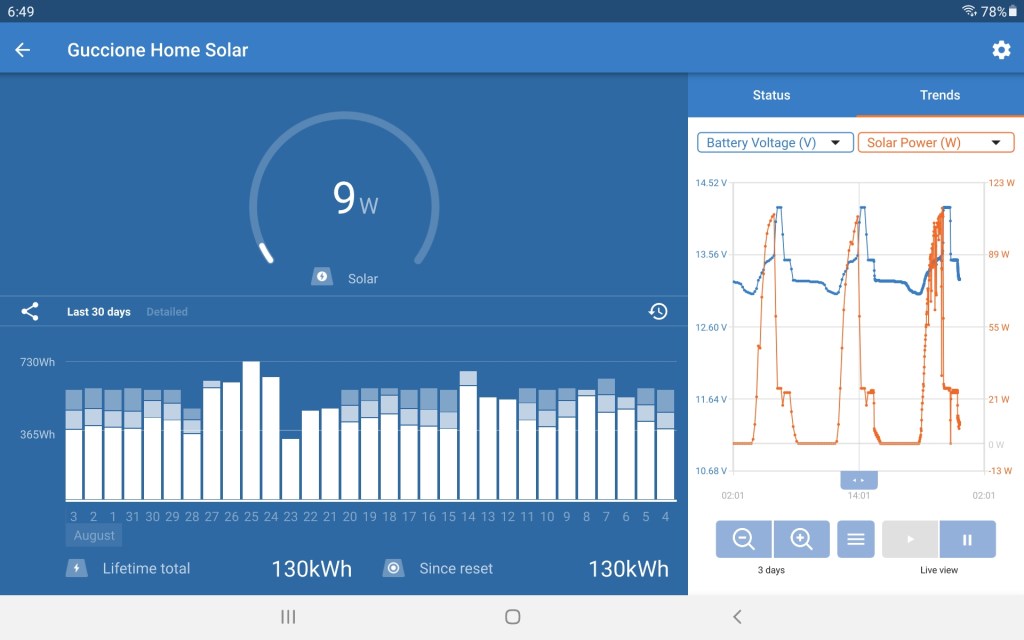
When I put up the solar testbed I realized it wasn’t wven close to a good place for solar panels. It was just convenient. As winter moved in I noticed the angle of the sun was lower than I realized. On November 16 I decided to angle the panels a bit more toward the sun. This led to noticably higher peaks on sunny days.
The panels were also close to the east side of the house which put them in the shade most of the afternoon. So I bought an extra 20 feet of wire and moved the panels east a bit. This was on December 7. Unfortunately, many of the days have been cloudy, but the chart below gives the output per day. And even as I moved the panels to get more sun, the days got shorter and the sun lower in the sky. But I still was able to see a new peak output.
Some points. I learned that angles aren’t as important as I expected. In fact, panels that track the sun gets maybe 20% increase in output. Not trivial, but probably not worth the effort in most cases. And since the angle of the sun varies so much over the year (and through the day!) the angle for a fixed panel is just a sort of compromise anyway. So mostly people just go with whatever angle their existing roof is (of course). One thing that I didn’t appreciate was the effect of shorter days in the winter. There are some calculators on line that let you play around with this but the longer days in the summer make a big difference. Finally a good sunny day is really dramatically different than a cloudy day. All of this pushes toward larger panel arrays and larger batteries for going completely off grid, depending on where you live.
The last bit has to do with the way output is measured. In the graph below the shaded boxes at the top of some of the bars indicate different battery charging modes. So the days without these shaded bits are days the battery doesn’t fully recharge. This also brings up the point that output is just what you use. Unless you completely drain the battery, this isn’t showing the actual (potential) output of the panels. I tried to put some larger loads on sunny days to see what sort of peak I could get, but even that is hard to plan.

Inside the Making of Jimmy Buffett’s Final Album
I am a lifelong Buffett fan. Saw him live in Biloxi when I was in high school in the late 1970s and have been enjoying his music ever since. His last album is very good. I think even non-fan will find something to like. A good review below. Somehow the review touched on nearly every song but then one I like the most: Johnny’s Ruhm.
Inside the Making of Jimmy Buffett’s Final Album
FPGA vs GPU Computing
In the 1990s it became clear that the decades long increases in microprocessor performance was reaching some limits. Accelerators were an active area of research. These were architectures that broke the long standing so-called von Neumann model. Probably because of my hardware background, I gravitated toward FPGAs. My own Ph.D. explored ways to use FPGAs to do general purpose computation.
Similar work was going on at Stanford, most prominently by Ian Buck. If it was even a rivalry it was a friendly one. I recall exchanging email with Ian, but don’t think we ever met in person. The FPGA and GPU conferences were distinct at the time, and probably mostly still are.
Ian went off to Nvidia and I went off to Xilinx, both of us pursuing general purpose computing on our respective architectures. To be fair, GPUs had some short term advantages, mostly in programmability, but FPGAs had long term advantages in latency, power and perhaps peak performance.
After almost a decade of FPGA compute, I went over to the GPU camp and built very large hybrid GPU clusters for the financial services sector. These were some of the earliest and biggest GPU installations. I kept peeking at FPGAs and even did a small in-house comparison to Nvidia GPUs but GPUs were already established, if not entrenched, in the data center. FPGAs weren’t too bad, but no particular advantage that would warrant a shift away from GPUs.
Nvidia had invested in compute in both software and modifications to their architecture. Xilinx (and other FPGA makers) made a few attempts to support compute, and for things like DSP it is still a good solution. But 20 years on, Nvidia has ridden compute acceleration to a trillion dollar market cap. Xilinx and Altera have both been acquired by traditional CPU companies (AMD and Intel, respectively) and still have respectable multi-billion dollar businesses in their traditional markets. One can’t help but admire Nvidia management for doggedly pursuing compute and their current success.