Raspberry Pi OS vs Ubuntu

A while back I decided to have a go at using a Raspberry Pi 4 as my primary desktop machine. I went with Ubuntu for the OS which was a bit of a slog at first, but these days it is pretty well supported, mostly. I currently have three other Raspberry Pis in the house, two Raspberry Pi Zeros being used for network monitoring and as a lawn sprinkler controller and a Raspberry Pi 4 on the downstairs TV for streaming.

I didn’t have much choice and stuck with the Raspberry Pi OS for the Zeroes, since I Ubntu wasn’t available. It was only 32-bit bit for the simple embedded applications it was enough. I also had a Zero side project to display images on a TV, a bit like those LCD photo frames. A Zero was good enough for that sort of thing and I used Raspberry Pi OS again.

Ubuntu on the TV became a bit of a problem. The GPU support is lacking and you really need to GPU to watch video. Every time Ubuntu would update, it would silently clobber my GPU support. Last night I decided to dump Ubuntu and go with Raspberry Pi OS. It took no time at all to install and configure and the resulting video was so clean my wife even commented on it.

I suppose for now I will stick with Ubuntu on the desktop and deal with the spotty support, but I think all of my future Pi projects will be using Raspberry Pi OS.
Who Watches TV?

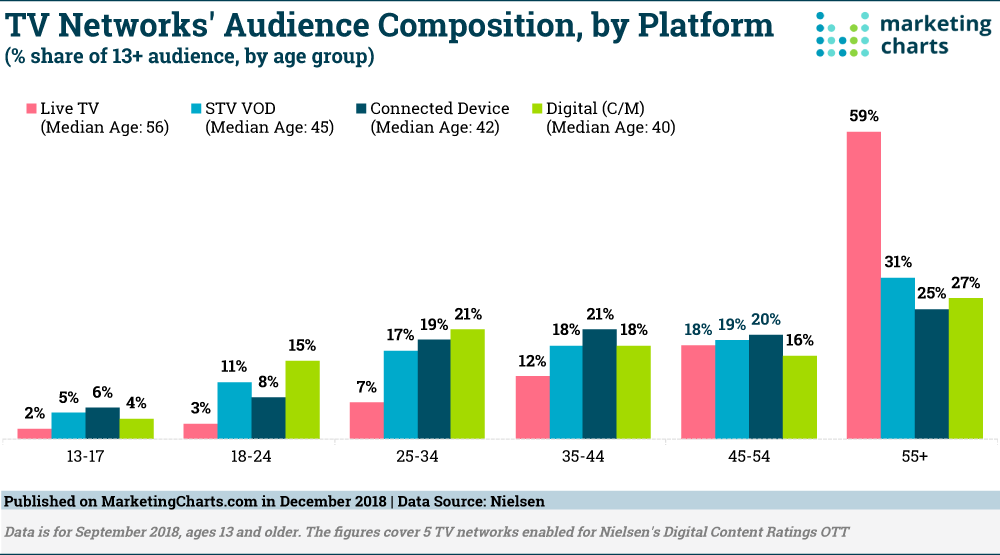
When I think of all the misinformation and conspiracy theories circulating these days I always blame The Internet. I was curious about who is spending time on the internet, since you might think people more prone to believing misinformation are the people spending the most time on the internet. It seems like there is a more interesting question. Who is watching broadcast TV vs other on demand streaming media?

How the Median Age of TV Viewers Differs Across Platforms

The Opium Wars

I remember something about The Opium Wars from history class. I knew it involved the British and China. I assumed it was an early War on Drugs, with the British trying to stop the sale of opium from China. Actually it was quite different. The British wanted to be able to import and sell opium into China. Opium had been banned by the Chinese government and the British went to war, and won, over the ability to sell opium in China.

Today the news is about the end of the 20 year US war in Afghanistan. I recall that Afghanistan produced something on the order of 90% of the worlds heroin. I wondered what the effect of the war on heroin production was. Like the Opium Wars it was not at all what I assumed.

It seems the Taliban all but halted opium production in Afghanistan, only to have it return once they were driven out by the US forces. There also appears to be connections between the Afghan government supported by the US and the drug trade. I am sure this could be a complicated situation, yet this raises lots of questions. I found an article that appears to have legitimate data but is critical of the US involvement. I tracked down the source and it appears to be a legitimate academic source, but affiliated with Russia. Worth a read, just for the opposing view. It also touches on the heavy use of private “contractors” in the conflict.

The Politics of Heroin and the Afghan US Pullout

The Texas GOP’s war on governing

I have posted lots of articles on what I am calling the Failed State of Texas. This is a good one, from Vox, but I will limit these in the future. It has basically all been said at this point. I’m will add one point about where governments, in my opinion, go wrong. When your government holds power by means other that popular support for policies, you are living in a failed state. It has nothing to do with left or right, rich or poor. I will double down on this and say that if the same group of people is running your city / state / country for more than say, a decade, you are living in a corrupt, failed state.

The Texas GOP’s war on governing

Punishing Austin

A good read about the abusive relationship between the governor of Texas and the large cities. Austin has long been they target for this sort of pettiness, but as Dallas and Houston and even places like Williamson and Hayes county turn Blue, the people living in these places are also on the receiving end of this nonsense. Of course, the vast majority of the wealth and economic activity is in these urban areas, especially now that oil and gas are winding down. A sort of economic apartheid.

Texas Republicans love to punish Austin. Now the pandemic is doing it for them.