I am a lifelong Buffett fan. Saw him live in Biloxi when I was in high school in the late 1970s and have been enjoying his music ever since. His last album is very good. I think even non-fan will find something to like. A good review below. Somehow the review touched on nearly every song but then one I like the most: Johnny’s Ruhm.
FPGA vs GPU Computing
In the 1990s it became clear that the decades long increases in microprocessor performance was reaching some limits. Accelerators were an active area of research. These were architectures that broke the long standing so-called von Neumann model. Probably because of my hardware background, I gravitated toward FPGAs. My own Ph.D. explored ways to use FPGAs to do general purpose computation.
Similar work was going on at Stanford, most prominently by Ian Buck. If it was even a rivalry it was a friendly one. I recall exchanging email with Ian, but don’t think we ever met in person. The FPGA and GPU conferences were distinct at the time, and probably mostly still are.
Ian went off to Nvidia and I went off to Xilinx, both of us pursuing general purpose computing on our respective architectures. To be fair, GPUs had some short term advantages, mostly in programmability, but FPGAs had long term advantages in latency, power and perhaps peak performance.
After almost a decade of FPGA compute, I went over to the GPU camp and built very large hybrid GPU clusters for the financial services sector. These were some of the earliest and biggest GPU installations. I kept peeking at FPGAs and even did a small in-house comparison to Nvidia GPUs but GPUs were already established, if not entrenched, in the data center. FPGAs weren’t too bad, but no particular advantage that would warrant a shift away from GPUs.
Nvidia had invested in compute in both software and modifications to their architecture. Xilinx (and other FPGA makers) made a few attempts to support compute, and for things like DSP it is still a good solution. But 20 years on, Nvidia has ridden compute acceleration to a trillion dollar market cap. Xilinx and Altera have both been acquired by traditional CPU companies (AMD and Intel, respectively) and still have respectable multi-billion dollar businesses in their traditional markets. One can’t help but admire Nvidia management for doggedly pursuing compute and their current success.
Swimming Pool Maintenance Thoughts
I have been involved in maintaining a suburban swimming pool, on and off for pretty much my entire life. Through trial and error (some large errors) I have managed to keep my own pool relatively clean and light on chemicals. A friend was asking about this and I would really like to make this a sort of project and formalize some of information, perhaps with actual numbers. Of course it is hard to experiment with something like a home swimming pool, but in some ways I have been doing that all along. Some notes for future reference.
Chlorine: the pool I grew up with at my father’s house was old school. Dad had a 50 gallon drum of HTH chlorine granules in the dressing room behind the pool. Dangerous stuff, in so many ways. As best I could tell he would throw a few scoops in after busy swimming weekends or when the water looked greenish. There was a test kit in a blue plastic box that looked like a chemistry set. I saw him use it occasionally but not very often. I have one too, and haven’t used mine is years. I confess I find the results too hard to read. More on testing later. Chlorine is used as a disinfectant. I suppose this is important but there seems to be better ways to do this today. It is also used to kill algae. I am suspicious that this isn’t a great idea.
pH: Acidity is important for a pool in that it keeps the water from burning eyes and even skin. It’s also key to using chlorine, since chlorine stops working at less neutral pH levels. A special acid, cyanuric acid, is added to pools to stabilize chlorine, but it seems to be independent of the measured pH. Cyanuric acid is added to commercial chlorine as “stabilizer”. The only problem is it accumulates in the water and leads to all sorts of problems, including destroying the plaster pool surface. My father would adjust pH by pouring muratic acid from plastic gallon bottles into the pool. This was all very seat of them pants flying and not something I ever did regularly.
pH Buffering: this is one I understand more in theory than practice. Buffering makes it more difficult for the pH to change, presumably from neutral or close to it. Borax seems to be a recent addition to the pool maintenance chemicals. Other buffers are available and can be bought commercially.
UV Sterilization: there are products that use UV light to sterilize water. This, in many ways, takes the place of chlorine. I have not used this in my pool but have used it in a pond with excellent results. It is some what expensive and requires physical modifications to the plumbing and requires electricity.
Salt Water / Chlorine Generation: another modern technique. Another unit that will require somewhat pricey modification of the plumbing and requires electricity. It also requires salt to be added to the pool. This is at a somewhat low concentration, maybe a tenth the saltiness of seawater. It’s not unpleasant.
Mechanical Filtration: all pools have a filter, usually sand, cartridge or diatomaceous earth (D.E.). These remove large particles from the water. People historically run pool pumps maybe a third of the day. This seems to be a questionable idea. One way to keep water clean is to keep it moving. The dirt in a filter is also a great place to breed all sorts of things if left stagnant. Some people have recently proposed running a pump 24 hours a day. This would seem to perhaps allow a smaller pump and less chemicals. This one needs lots more exploring.
Pool Covers: yeah a hassle but they save on water and chemicals. It should probably be considered a part of a pool, not an option.
Copper: when there was an chlorine shortage a few years back I bought a floating solar gadget that put copper into the pool. I learned that copper kills algae pretty well, and I could stop using chlorine as an algicide. Too much copper can be bad and will stain white pool surfaces. When I got to the recommended level (0.2 ppm?) I stopped using the gadget. The lack of green algae has been amazing. One small problem I encountered was emerging of a darker growth, possible the dreaded Black Algae. This isn’t algae at all it turns out, but a bacteria, and was probably a result of chlorine being too low. I found a bit of chlorine and some brushing got rid of it quickly. YMMV.
Testing: all of the chemistry really requires lots of testing. Chlorine testing seems to be the most common in modern pools but I would lean toward pH as being as important. My problem is test kits and strips are too hard to read accurately. I bought a simple digital lab liquid pH tester but when I found out it required calibration I put it aside. I plan to revist this since the idea of a simple digital pH meter is so attractive. I would rely on a commercial service to test other water parameters a few times a year. This would be possible in a stable environment with little change to the water chemistry.
So what would I do today if I had a choice? I think I would go with salt water and a chlorine generator. Also a UV sterilizer. I would look into a 24 hour pump / filter combination (even though this is a bit unconventional). I would check into borax and keep a low level of copper in the water. Add cyanuric acid once as stabilizer and forget it. The big question would be sizing all of these parts. I believe there may be some inexpensive units for UV sterilization and even filtration that are used for home aquarium and ponds. I would also like to revist my little digital pH meter. Are there similar ones for alkalinity and chlorine? How would they be calibrated?
Final Thoughts: I had a good experience with a combined UV sterilizer / filter for a small pond. I ran it 24 / 7 and I wondered what a similar unit for a pool would look like. Add a chlorine generator and even some built in monitoring and I can imagine a relatively compact unit that would be an ideal pool maintenance machine.
The Full Reset
I worked in tech my entire adult life, including a few start ups. The goal was to move fast, and nothing slowed you down more than ‘legacy’. This years product that needed to be compatible with last years. The mistakes of the past seemed to get amplified as time went on, and competition without these restrictions often sailed right past. A short article on legacy thinking from the Collaborative Fund.
The Full Reset
LED Lighting and the Energy Transition
I am using a couple of lightbulbs for the test load for my solar testbed. I was using either one or two standard bulbs which consume maybe 10W each. Not much of a load really. I started looking around for something a little bigger and realized there wasn’t much that you can run 24 / 7 that uses much electricity. I happened to have two old incandescent bulbs that weigh in at 60W or so each and they are about the best I can do.
Funny thing is the 10W LED bulb puts out about as much light as the old 60W incandescent. That’s significant. It certainly makes things like home solar much easier to manage. The idea of “keeping the lights on” isn’t such a big deal. The next step, I suppose, is keeping the A/C (or heat) on.
Wilhoit’s Law
Just ran across something called Wilhoit’s Law. Misattributed but I found it in the comments on the Crooked Timber posting below. Funny I used to read Crooked Timber many years ago but it fell off my radar. My take is it’s all State Capitalism by other names.
Conservatism consists of exactly one proposition, to wit: There must be in-groups whom the law protects but does not bind, alongside out-groups whom the law binds but does not protect.
Frank Wilhoit
Silicon Valley’s worldview is not just an ideology; it’s a personality disorder.
Research on Iodine Deficiency and Goiter in the 19th and Early 20th Centuries
Was reading about iodine deficiency in another site but got cut off. This article tells the same story. I remember seeing people with goiters when I was a kid. Scary stuff.
Research on Iodine Deficiency and Goiter in the 19th and Early 20th Centuries
Solar Power and Angles
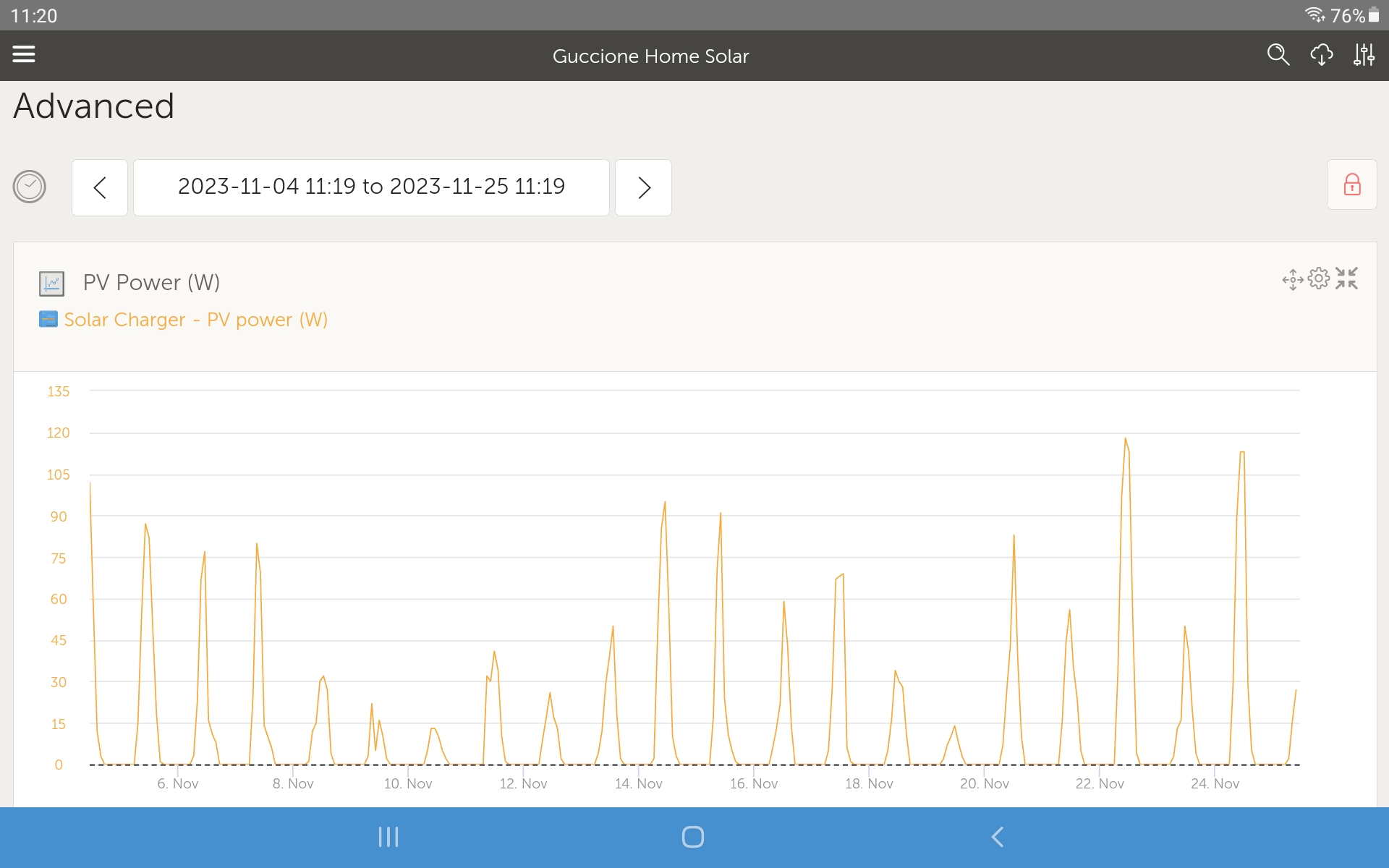
Below is a graph of the recent output of the solar testbed from the Victron VRM. The last two large spikes are after tilting the panels. None of this was very scientific, with the angle being determined by the available size of the angle iron (five feet, cut in half for two 2.5 foot lengths). I estimate this is about a 22 degree tilt, maybe half of optimum.
Qualitatively there is a significant improvement in output, maybe by a third, on sunny days. The two large spikes are the days before and after Thanksgiving, which we’re full sun all day, with Thanksgiving being mostly cloudy.
The lessons: angle is important. Shady days will produce a bit, but full sun is where the real productivity is. Most home installations won’t have too many choices for angle and the weather is going to be even further beyond our control. But some good parameters to get a feel for.
The Biggest Hidden Bias in Politics
From The Garden of Forking Paths. I will add this is somewhat incomplete. It always seems the people with the craziest ideas are the ones that always want to discuss them. And by”discuss” I mean have you listen to them rant and rave. They tend to be obsessives which mostly means they won’t change their mind, and they won’t change the subject.
The Biggest Hidden Bias in Politics
NASA’s EMIT Has Accidentally Become a Secret Weapon for Fighting Climate Change
Great stuff. Probably good for finding nearby Taco Bells too.
 Steven A. Guccione