 Early Weekend reading:
CORMAC MCCARTHY’S BLOOD MERIDIAN WAS ALMOST A PLAIN OLD WESTERN
THE SNEAKY LITERARY INFLUENCES BEHIND A MODERN AMERICAN CLASSIC
Just ran across this today. Never heard of it before.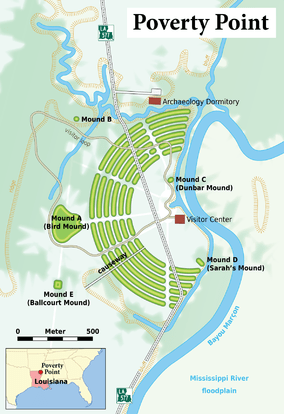 From the Wiki page:
Poverty Point comprises several earthworks and mounds, built between 1650 and 700 BCduring the Archaic period in North America, by a group of Native Americans of the Poverty Point culture. The culture extended 100 miles (160 km) across the Mississippi Delta. The original purposes of Poverty Point have not been determined by archaeologists, although they have proposed various possibilities, including that it was a settlement, a trading center, and/or a ceremonial religious complex.
The 910-acre (1.42 sq mi; 3.68 km2) site, which has been described as “the largest and most complex Late Archaic earthwork occupation and ceremonial site yet found in North America“[4] is a registered National Monument. The monument was brought to the attention of archaeologists in the early 20th century, when it was given the name of Poverty Point after a nearby plantation.

Wealth inequality is getting lots of attention lately, but I think America is winding down its post-war boom (and Boomers). It remains to be seen what economic and political direction the country will take. I always found it funny that “America” is really just a part of North America, sandwiched between Mexico and Canada. In many ways we split the difference.
The American Dream Is History
From Nicholas Kristof in the New York Times:
Why 2017 Was the Best Year in Human History
“Every day, the number of people around the world living in extreme poverty (less than about $2 a day) goes down by 217,000, according to calculations by Max Roser, an Oxford University economist who runs a website called Our World in Data. Every day, 325,000 more people gain access to electricity. And 300,000 more gain access to clean drinking water.
A blog post from 2010 discussing why the federal government controls offshore oil and gas, not the states. This only since 1950 and the result of a deal not taken by Louisiana governor Earl Long.
Earl’s big blunder (no thanks to Leander Perez)
“Dodd, in his book, speculated that the immediate loss to the state was $66.5 billion, not including billions more paid in bonuses and leases, plus the severance taxes that would have amounted to about a fourth of the total value of production. Dodd said the cost as of 1986, when he wrote his book, was “$100 billion plus,” with future losses as much as $10 billion a year.
From Bloomberg’s Jealousy List 2017. I try to keep this blog away from politics, but this one is personal. I grew up in Louisiana in the David Duke era and his popularity still baffles me. How could so many of my nice friends and neighbors support a guy like Duke? I guess you could ask that question about a lot of leaders throughout history. So I will file this one under history. I also like the prescient quote from Walker Percy.
The Nationalist’s Delusion
“While the rest of the country gawked at Louisiana and the Duke fiasco, Walker Percy, a Louisiana author, gave a prophetic warning to The New York Times.
“Don’t make the mistake of thinking David Duke is a unique phenomenon confined to Louisiana rednecks and yahoos. He’s not,” Percy said. “He’s not just appealing to the old Klan constituency, he’s appealing to the white middle class. And don’t think that he or somebody like him won’t appeal to the white middle class of Chicago or Queens.”
I used to read Paul Krugman’s blog daily. A good one to start the new year about the towns and the cities.
The Gambler’s Ruin of Small Cities (Wonkish)

 Steven A. Guccione