
Month: July 2018
Austin firefighters respond to blazes caused by spontaneous combustion of tortilla chips
 How hot is it in Austin?
Austin firefighters respond to blazes caused by spontaneous combustion of tortilla chips
By Elizabeth Elkin and Brandon Griggs, CNN
Updated 4:06 PM ET, Fri July 20, 2018
USENET
Many years ago, when the internet was a new thing, there was something called USENET. It was a bit like today’s social media. Really a series of long-running chat rooms, but populated pretty much all by techies and university people. It was lots of fun and I remember there being about 300 groups and you could (literally) read them all, every day. Heck, they were coming in over a phone line at 2400 baud, so it was easy to keep up. You also saw many of the same people every day and it was a bit of a community. Not much was ‘serious’, just young people at play.
I just found a folder with about 25 files of things from USENET that the younger me found important enough to save. I found one from 1990 that struck a nerve. I am not exactly sure why I saved it, but I suppose this is always the fear in a free society, that people will use the openness and freedoms to, ju-jutsu-like, eliminate those very freedoms.
I have the original poster’s name, but I won’t reproduce it here. I was able to Google him and see he is a techie and in the same field as me. He was even a professor at a large California university for a while. I might have to drop him a note. Below are the parts he quoted, from the book They Thought They Were Free:
[The ellipses are all mine. Italics are denoted by *asterisks*. — Author of USENET Post]
“What no one seemed to notice,” … “was the ever widening gap … between the government and the people. … And it became always wider. …
“What happened here was the gradual habituation of the people … to be being governed by surprise; to receiving decisions deliberated in secret; to believing that the situation was so complicated that the government had to act on information which the people could not understand, or so dangerous that … it could not be released because of national security. …
“This separation of government from people … took place so gradually and so insensibly, each step disguised (perhaps not even intentionally) as a temporary emergency measure or associated with true patriotic allegiance or with real social purposes. And all the crises and reforms … so occupied the people that they did not see the slow motion underneath …
“… the whole process of its coming into being, was above all *diverting*. It provided an excuse not to think for people who did not want to think anyway. I do not speak of your ‘little men’ …; I speak of my colleagues and myself, learned men, … . Most of us did not want to think about fundamental things and never had. … Nazism gave us some dreadful, fundamental things to think about … and kept us so busy with continuous changes and ‘crises’ and so fascinated … by the machinations of the ‘national enemies,’ without and within, that we had no time to think about these dreadful things that were growing, little by little, all around us. …
“To live in this process is absolutely not to be able to notice it … unless one has a much greater degree of political awareness … than most of us had ever had occasion to develop. Each step was so small, so inconsequential, so well explained or, on occasion, ‘regretted,’ that … unless one understood what the whole thing was in principle, what all these ‘little measures’ that no ‘patriotic German’ could resent must some day lead to, one no more saw it developing from day to day than a farmer in his field sees the corn growing. …
“How is this to be avoided … Many, many times since it all happened I have pondered that pair of great maxims … ‘Resist the beginnings’ and ‘Consider the end.’ But one must foresee the end in order to resist … the beginnings. … and how is this to be done …? …
“Your ‘little men’, …, were not against National Socialism in principle. Men like me, who were, are the greater offenders …
“… One doesn’t see exactly where or how to move. … Each act, each occasion, is worse than the last, but only a little worse. You wait for the next and the next. You wait for one great shocking occasion, thinking that others, when such a shock comes, will join with you in resisting somehow. You don’t want to act, or even talk, alone; you don’t want to ‘go out of your way to make trouble.’ … And it is not just fear … that restrains you; it is also genuine uncertainty.
“Uncertainty is a very important factor, and, instead of decreasing as time goes on, it grows. Outside, in the streets, …, ‘everyone’ is happy. One hears no protest, and certainly sees none. … you speak privately to your colleagues, some of whom certainly feel as you do; but what do they say? They say, ‘It’s not so bad’ or ‘You’re seeing things’ or ‘You’re an alarmist.’
“And you *are* an alarmist. You are saying that *this* must lead to *this*, and you can’t prove it. … On the one hand, your enemies … intimidate you. On the other, your colleagues pooh-pooh you as pessimistic or even neurotic. You are left with your close friends, … people who have always thought as you have.
“… in small gatherings of your oldest friends, you feel that you are talking to yourselves, that you are isolated from the reality of things. This weakens your confidence still further and serves as a further deterrent to – to what? It is clearer all the time that, if you are going to do anything, you must *make* an occasion to do it, and then you are obviously a troublemaker. So you wait…
“But the one great shocking occasion, when tens or hundreds or thousands will join with you, never comes. *That’s* the difficulty. If the last and worst act of the whole regime had come immediately after the first and smallest… But of course this isn’t the way it happens. In between come all the hundreds of little steps, some of them imperceptible, each of them preparing you not to be shocked by the next. Step C is not so much worse than Step B, and, if you did not make a stand at Step B, why should you at Step C? And so on to Step D.
“And one day, too late, your principles … all rush in upon you. The burden of self-deception has grown too heavy, and some minor incident, in my case my little boy … saying ‘Jew swine,’ collapses it all at once, and you see that everything, everything, has changed and changed completely under your nose. The world you were born in – your nation, your people – is not the world you were born in at all. The forms are all there, all untouched, all reassuring, the houses, the shops, the jobs, the mealtimes, the visits, the concerts, the cinema, the holidays. But the spirit, which you never noticed because you made the lifelong mistake of identifying it with the forms, is changed. Now you live in a world of hate and fear, and the people who hate and fear do not even know it themselves; when everyone is transformed, no one is transformed. …
“… Life … has flowed to a new level, carrying you with it, without any effort on your part. On this new level you live … more comfortably every day, with new morals, new principles. You have accepted things you would not have accepted five years ago, a year ago, things that your father … could not have imagined.
“Suddenly it all comes down, all at once. You see what you are, what you have done, or, more accurately, what you haven’t done (for that was all that was required of most of us: that we do nothing). … You remember everything now, and your heart breaks. Too late. You are compromised beyond repair.
Why Trump Has Such a Soft Spot for Russia
From New York Magazine by Andrew Sullivan. I shy away from political articles here, especially ones about the President, but I think this one is worth a read.
INTERESTING TIMES
Why Trump Has Such a Soft Spot for Russia
What veterans of the last financial crisis have to say about the next one
Looks like the people who guided the US economy through the last crisis are getting together for a very public meeting. I wish they would have invited Alan Greenspan, just to see if he learned any lessons. I wonder if they are getting worried. From WaPo:
What veterans of the last financial crisis have to say about the next one
“Former U.S. Treasury secretaries Henry Paulson and Timothy Geithner and former Federal Reserve Chairman Ben S. Bernanke met with reporters last week to discuss a September summit they are hosting to review lessons learned — both good and bad — from the crisis.”
A good description of what went wrong:
“The financial crisis reached its peak 10 years ago, a global banking panic that shook stock markets, wiped out thousands of companies, erased trillions of dollars in savings and drove unemployment from 4.7 percent to 10 percent in 24 months.
“To arrest the panic, the Bush and Obama administrations used controversial and — at times — barely legal methods to flood financial markets with taxpayer money. Most of this money flowed directly to banks, not homeowners, causing a populist revolt.
What they missed was the part about the housing bubble caused by Alan Greenspan and low interest rates.
Blood and Bones

Been enjoying the music of Bob Schneider for a while. His latest, Blood and Bones, is as good as anything he has ever done. If you like this, check out the King Kong trilogy from a few years back.
Trump’s Golf Misadventure in the Scottish Dunes
There was a good documentary on Netflix about Trump’s Scottish golf course development from several years back. Bloomberg revisits the controversy.
Trump’s Golf Misadventure in the Scottish Dunes
By Timothy L. O’BrienBroken promises and angry neighbors dog the president’s resort near Aberdeen.
Coffee Cup Microwave Scrambled Eggs


Was at an air BandB for vacation a couple of weeks back. The place had a fully outfitted kitchen with plates, spices, a juicer, coffee maker, and just about everything a kitchen would need. Except one thing. Not a pot or pan in the place. Very odd. We had bought some food and I was making breakfast when I noticed the missing pots and pans. I wondered if I could microwave some eggs. I remember my brother trying this when we were kids, with terrible results. The yolk exploded and covered the inside of our massive new Amana microwave with half cooked egg. So I was skeptical. But alas there were some recipes on line, including a few making scrambled eggs in a microwave in a coffee cup. Perfect! I gave it a try and in a bit more than a minute I had some very nice scrambled eggs. Put a dab of butter in, some salt and pepper (before or after cooking) and some of the best eggs ever. Easy cleanup, too. Why didn’t I know about this?
Electric Busses
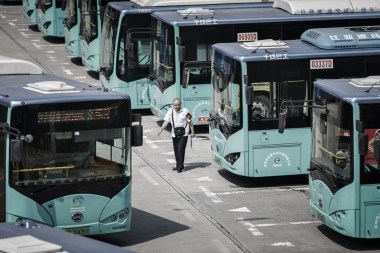 I was in Denver on vacation and noticed the quiet (almost dangerously so) busses on the 16th street mall. They seemed to be electric, but there weren’t any obvious signs or anything advertising this, just the lack of noise and smoke. When I got home a quick Google turned up an article on the electric busses in Denver (Denver RTD to purchase 36 new BYD electric buses for mall service). It also urned up the article on the all electric busses on Shenzhen. By coincidence I was talking to a co-worker who happened to be from Shenzhen. He confirmed the electric bus story and also mentioned that it is far, far easier to get a license for a new car in China if it is electric.
China producing x86 chips nearly identical to AMD server processors
 From Ars Technica:
China producing x86 chips nearly identical to AMD server processors
Thanks to a licensing deal with AMD and a complex joint-venture arrangement, the Chinese chip producer Chengdu Haiguang IC Design Co. (Hygon) is now producing x86-based server processors that are largely indistinguishable from AMD’s EPYC processors—so close in design that Linux kernel developers had to do little in the way of patching to support the new processor family, called “Dhyana.” The server chips are being manufactured for domestic use only—part of an effort to break China’s dependence on foreign technology companies.
 Steven A. Guccione