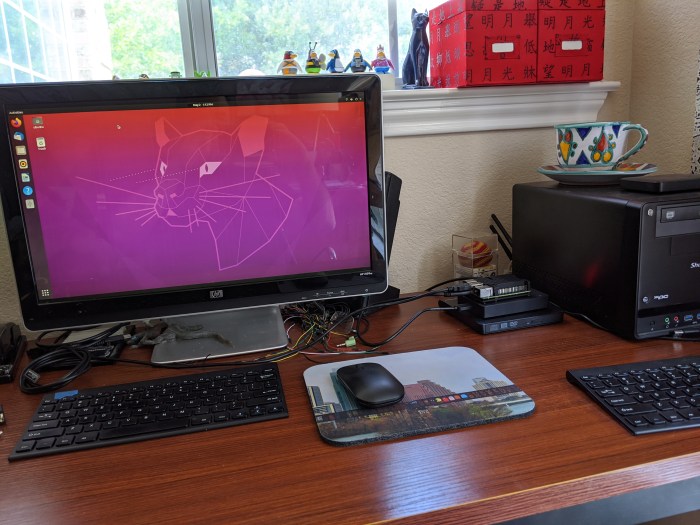
My Raspberry Pi 4 WiFi Hell

I think I may have finally gotten to the bottom of my Raspberry Pi 4 WiFi problems.  I installed Ubuntu 18 and the WiFi networking never worked properly.  It would work sometimes, then drop off randomly.  I thought it might be a hardware problem and returned the unit for a new one.  Still the same.  Thought it could be a power supply issue, so I offloaded everything on the USB to a powered USB hub.  It ran a bit cooler but that wasn’t it either.  There were lots of reports of signal issues when using certain hi-def HDMI modes on the monitor.  Nope that wasn’t it either.  I had a fancy metal heatsink case which was rumored to cause WiFi problems.  Nope.

Gave up an bought a USB dongle which appeared to work at first, then it didn’t.  Later I put the WiFi dongle on the end of a short USB cable, thinking that moving the WiFi away from the actual Raspberry Pi 4 unit might do something,  It seemed to work for a while. Then I upgraded to Ubuntu 20 (because I accidentally trashed my SD card).  Well, it was time to upgrade anyway.

After the upgrade there was no WiFi at all.  Found out that it had to be enabled in /etc/network-config.  Things were looking up.  Now I could boot up and see a reasonable WiFi.  But soon it deteriorated again.  More googling lead to all sorts of people with similar problems, including people using different versions of the Cypress firmware.  I didn’t want to go there. I would use a wired ethernet and wait for a fix if I had to.

Yesterday I read something that sounded worth pursuing.  Some people had WiFi set to the wrong country (UK for instance).  That would be a problem. I also noticed my 5 GHz WiFi wasn’t showing up.  Probably a warning sign I had ignored too long.

I’m not a networking or WiFi guy (and I don’t really want to be one) but a quick look turned up my WiFi country set to “country 00: DFS-UNSET“.  Probably not what I want.  Manually set it with “sudo iw reg set US” and immediately I saw my 5 GHz WiFi!  Seems more stable, and it should be.  Now I just have to figure out where to set this in the file system so I don’t have to remember to type this command after every reboot.

Pandemic Chores

Not much going on these days.  Moved some heavy rocks around the yard.  Been meaning to do that for years.  Cooked some red beans on the stove top, old style.  Working on my robot mower.  Looks like bad sensors.  Not sure what the fix is.  Have a call in to the manufacturer.  Got some takeout from a nice local place for my 25th wedding anniversary.  Originally planned to be in Paris, but what can you do?  Got my wife this cool little fountain as an anniversary present.  Got this little electric chipper to get rid of some brush piles in the back and to use the mulch in the beds in the front.  Slow going but I have lots of time.

Deaths of Despair

A good read by Nobel Prize winner Angus Deaton.  Don’t let the title put you off.  It reminds me of a time when I was working at a promising tech start-up and the country’s economic situation changed, abruptly.  An employee quipped that his job went from a high-risk, high-reward situation to a high-risk, low-reward situation. I think something similar has happened to the US in general, at least for the bottom 90% or so.  From the Boston Review.

Deaths of Despair

Boston Review talks with Nobel Prize-winning economist Angus Deaton about COVID-19, the relationship between culture, financial hardship, and health, and why capitalism’s flaws are proving fatal for America’s working class.

We Cannot “Reopen” America

Ran across this thoughtful article in The Bulwark.  Always interested in where these things are coming from, I looked at the masthead.  Claims to be “reporting free from the constraints of partisan loyalties or tribal prejudices”.  Don’t recognize any of the names, but there is one photo without an associated biography:. William Kristol.  I remember him as a right wing taking head who was an early supporter of the war in Iraq.  Wiki says he is a Democrat as of 2020, after a lifetime of what can only be called right wing, partisan Republican politics.  Interesting times.

As far as the article, it makes the case that places like Vegas and movie theaters will never reopen, in their current form.  For at least a year, maybe much, much longer, nobody is going to want to spend time in large places full of strangers. Fine with me.  I never really did like crowds, with the possible exception of Mardi Gras.

So are there alternatives?  For some reason I thought of the karaoke bars in Japan, which are really a collection of small rooms rented out by groups of friends for food, drink and singing.  Instead of one huge movie theater, how about lots of very small ones, with food and drink service?  You could pick the movie and the time that is convenient.  Maybe pick any movie, they way you would at home.  I know I have thought about having friends over to watch a movie, but there aren’t enough seats, etc. in my house.

These mini-theaters could also be great for watching sports, or even, uh, karaoke.  Same could happen in Vegas.  I suppose there is some appeal to that vast room full of clanging machines.  But maybe a smaller room for friends could be fun too.

I’m not sure how it is all going to change, but I am pretty sure it is all going to change.

Oh, air travel.  More than ever there is a case for high speed rail which can provide more room and separation than feasible on an airplane.  I have taken high speed rail in Europe and Asia and find it much better than air travel in just about every way.  I say lets get to it!

We Cannot “Reopen” America

No matter when government stay-at-home orders are revoked, the American economy will not reopen. Because the source of the economic shock is not government orders. It’s the pandemic.

Ubuntu on the Raspberry Pi 4 Redux

img_20200502_131228

Last week I went to format a new 128 GB SD card using my USB card reader on my Raspberry Pi running Ubuntu.  Turns out I (at some point) reformatted my main Linux drive, which happened to be on an identical SD card.  I didn’t even realize what I had done until I went to reboot several days later.

I had decided to run off of a USB HDD drive, but this was more complicated than I expected.  I figured I could just re-install Linux on the SD card and make the few mods to the boot root and all would be fine.  Well, after many hours, I still couldn’t get back to where I was.  So today I decided to do a clean install.  I was originally using an old 32 GB SD card which seemed small but with my new 128 GB maybe it is best to run everything from the SD card and just mount the USB HDD for media (which is where all the disk space is used anyway).  Then I could even do backups on the USB drive and not have to worry about all the complications of having two OS copies, one on the SD card and one on the HDD.

First step was to download Raspberry Pi 4 Ubuntu install disk.  Good news is that 20.04 is now available, while I was on 18.04.  An sudo apt-get update and sudo apt-get upgrade got me a clean copy.  Then a sudo apt-get install ubuntu-desktop got me the UI.  Couldn’t be easier.  Now all I have to do is set up my use account, move the files over and mount the USB HDD.  And install things like Chrome and Plex.  Oh, and set the timezone and hostname.  Etc.  Going to take a break first.

One lesson:  I almost decommed my old x86 Shuttle PC.  Turns out you need a second system when things go bad. I suppose if I had a good bootable SD flash card I would have a fighting chance, but it sure was easier having another machine to work from.

Oh, checked the WiFi.  Still broken.


Some COVID-19 Math

I heard a commentator say today that there are one million people in the US who have recovered from COVID-19.  At first this sounds good until you realize there are 330 million people in the US, so this is about a third of one percent.  This is almost certainly an undercount with the real number unguessable, given the lack of testing.  But let’s say that is true.  There have been 60,000 deaths, which is also almost certainly an undercount.  Multiply that by 330 and you get almost 20 million dead after everyone else in the US recovers from COVID-19.

Not reliable numbers, but then only ones we have.  Oh, and let’s say this took three months.  To run its course it would take 900 months or …. 75 years.  Somebody check my math.  I wonder how Sweden looks.